Introduction
Physical activity is vital for children’s and adolescents’ health, growth, and development. It helps improve physical health by reducing the risk of noncommunicable diseases such as type 2 diabetes, cardiovascular diseases, and certain cancers (1). In Venezuela, the ongoing economic and social crisis has created many problems, such as rising poverty and food shortages, which profoundly affect the health of children and adolescents (2). Therefore, the environment in which most children and adolescents are living is immersed in deficiencies, lack of services, and inappropriate sanitation. This is consistent with the reported 40% of children under five years old showing growth deficit, and 33% of children aged 0-2 suffering from chronic undernutrition (3) In this context, the role of physical activity becomes even more crucial, as it may serve as a mitigating factor for the harms of the economic and social crisis: physical activity has been linked to both increased immune function (4) and long-term chronic disease prevention. (5).
Previously, there has been research into the status of physical activity of children and youth, such as the 2018 Venezuela Report Card on Physical Activity for Children and Youth that reports that 71% of adolescents ages 15-19 are inactive, not meeting the recommended 60 minutes of physical activity at least four times a week (6). Only 34% of adolescents in this age group participate in organized sports. However, 63% of adolescents are engaged in active transportation, such as walking for at least 10 minutes to get from one place to another due to a lack of public transportation. Concerningly, in Caracas, at some educational institutions, 22% of male adolescents are classified as obese and 10% as overweight, while 16% of school-aged children (7-8 years old) show signs of cardiovascular risk due to high blood pressure (7).
In this situation, reinforcing the pillars of well-being- sleep, stress management, adequate nutrition, and physical activity- is essential to maintaining the well being of children and youth or at least ensuring no deterioration of their statuses. Among those pillars, physical activity can be achieved by reinforcing the environment of children, which might be translated into low-cost implementations and savings as physical activity is a way to prevent future chronic diseases (8).
There is a National Plan of Sport, Physical Activity, and Physical Education 2013-2025 that highlights the relevance of physical activity for the Venezuelan population and which establishes the goals for the years between 2013-2025. This document describes Venezuela’s strategic direction for these areas over 12 years, aligned with the country’s Economic and Social Development Plan. It focused on expanding access to physical education and sports for the whole population while professionalizing high-performance sports to establish Venezuela as a global sports power (9)
The referred situation underscores the urgent necessity for effective strategies to encourage physical activity among children and youth in Venezuela. In partnership with the Active Healthy Kids Global Alliance (AHKGA), this study aims to contribute to the future update of the Venezuela’s Report Card on Physical Activity for Children and Youth. This project will depict physical activity patterns, identify challenges and opportunities, and contribute to the Global Matrix. The future work at the Global Matrix will also help compare Venezuela with other countries and guide efforts to promote healthier, more active lifestyles for young people in Venezuela. The objective of this study was to identify the information available on the physical activity patterns among children and youth in Venezuela, in the past 21 years, to describe key trends, challenges, and opportunities to promote active and healthy lifestyles.
Methods
This is a mixed-methods descriptive study that included a literature search of documents, including peer-reviewed articles, official governmental documents, and academic documents, to identify the available information on the physical activity patterns among children and youth in Venezuela during the past 21 years (from January 2003- until the end of 2024). Additionally, qualitative interviews about barriers and supports for physical activity were held with two experts, one in the nongovernmental organization (NGO) sector (Martha Palma Troconis, as CEO of Guerreros Azules, an organization that bring assistance to children and youth with diabetes in Venezuela, and the other in the academic sector (Prof. Rolando Carrizales, who is a professor at Universidad del Zulia, College of Education in the concentration of physical activity). Commonalities/ Differences/Complementarities were assessed between their answers. Below is the description of the process of identification and inclusion criteria.
Identification
The researchers considered four factors during the identification stage to cover the entire body of literature: database, keyword, source type, and period.
The search was performed by introducing keywords: Physical activity, exercise, sports, preschoolers, schoolchildren, adolescents, Venezuela, in English and Spanish: Actividad fìsica, ejercicio, deportes, pre-escolares, ninos en edad escolar, adolescentes, Venezuela, in search motor engines such as Google, Google Academics, Scielo, and PubMed.
Screening and eligibility
After identifying articles, the screening stage was performed by removing duplicates from the four databases.
From the total number of articles and documents obtained, criteria for inclusion/exclusion were applied: those not relevant to children and youth, those with Latin American data not including Venezuela, and those with topics not relevant to this review.
Inclusion criteria
In the inclusion stage, the full paper was scanned to ensure consistency with the established keywords. The researchers included only those articles and reports focused on Venezuelan children and youth, related to health, physical activity, exercise, nutrition, and factors that impact those dimensions.
An emphasis on checking the following topics was made:
Food Intake, Food Security, School Programs, Sports for Children and Youth, Education Activities, Sedentary Behaviors, Cardiovascular and Diabetes Risk Factors, Community and Environment, Active Transportation, Activities for Children with Disabilities, Infrastructure, Policies and Programs, Cultural Factors, Behavior, Sedentary Behavior.
Name of the motor search used:
Google, Scielo, Pub Med, Official and Academic local sources (e.g., ENCOVI), Science Direct, Research Gate.
Results
One of the results was the difficulty of finding relevant published articles. Obtaining accurate and recent data from Venezuela is challenging, however a total of 41 documents were identified, and after careful screening, checking the inclusion criteria (time period and matching topics) and eliminating the duplicates (12), a total of 29 articles remained in this first phase: categorized as follows: 25 peer reviewed articles: 15 primary peer-reviewed articles, and 10 secondary peer-reviewed articles; 4 non peer-reviewed articles: 2 reports, which are primary but not peer-reviewed, 1 working paper, and 1 report card. No newspaper or portal news articles were included.
Seventeen articles remained after double checking for duplicates, being not relevant for children and youth physical activity, or not matching the country specificity, as some of the originally identified studies in Latin America did not include Venezuela, therefore a final number of: 12 primary peer-reviewed articles and 5 secondary peer-reviewed articles were included in this revision. Figure 1 shows the process of the review and the articles obtained.
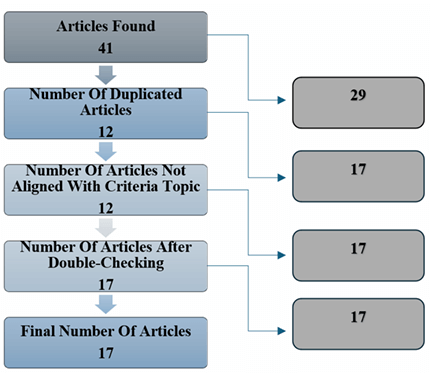
Figure 1: Articles Remaining After Applying Systematic Review Criteria
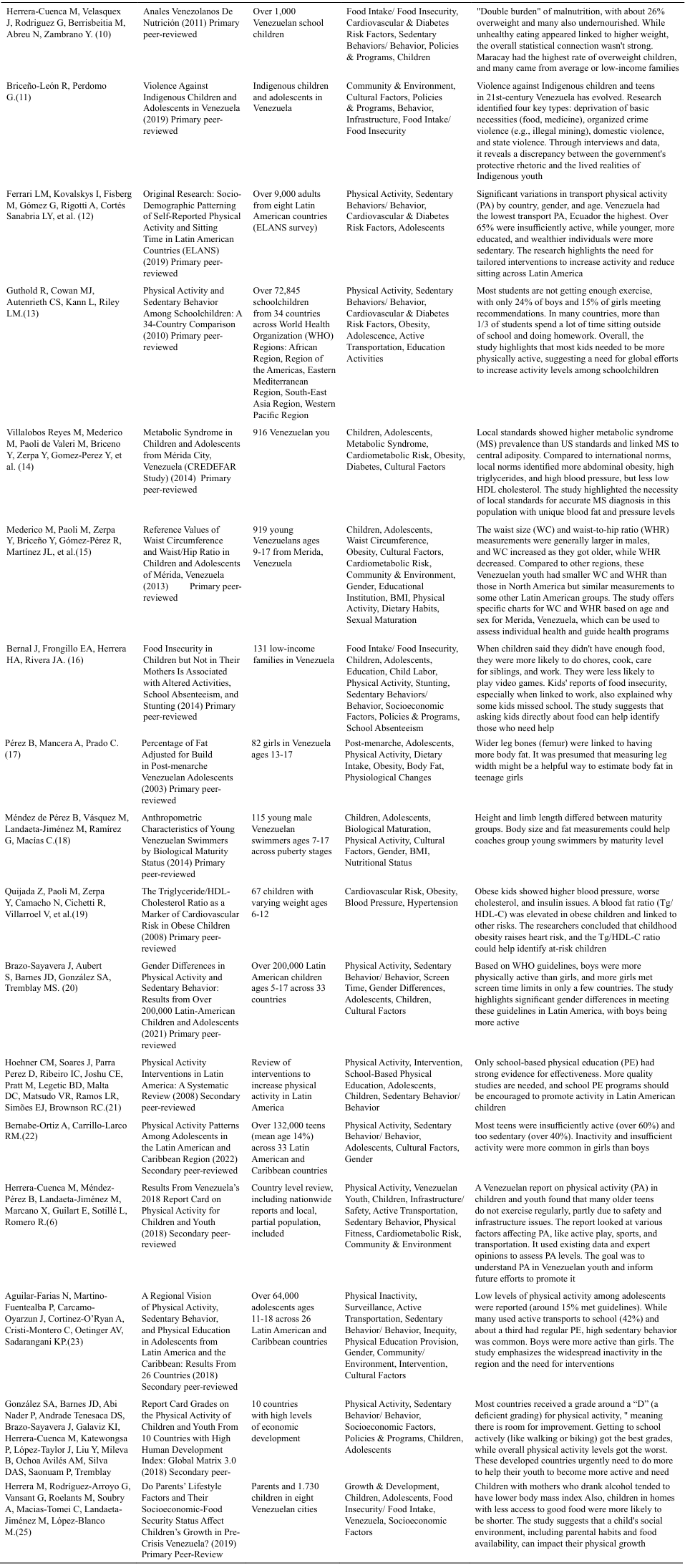
In the review of articles, the following factors were identified as having a relationship (either promoting or resulting from) the physical activity environment: food insecurity, cardiovascular and diabetes risk factors, dietary habits, policies, stunting, cultural factors, gender, school absenteeism, and community environment (Table 1).
Table 1: Factors of Physical Activity Patterns Among Children and Youth in Venezuela (n=17)
The interviews, showed below, identified similar challenges of concern with infrastructure and limited physical activity time in school. They noted that the infrastructure and practices around physical activity do not meet the standards of the law that supports physical activity for youth in Venezuela (Table 2).
Table 2: The following table describes expert interviews
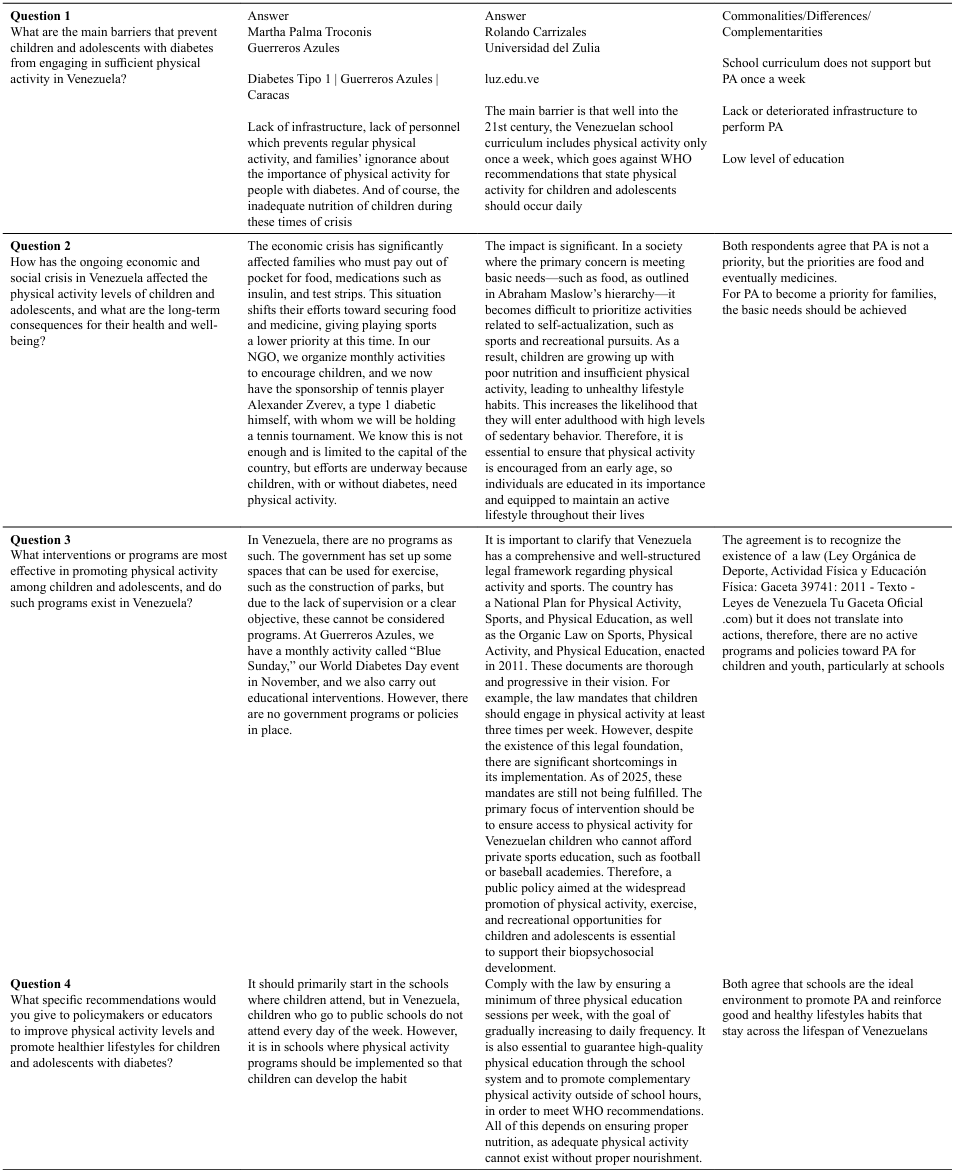
Overall, the results show several impairments— such as growth retardation, undernutrition, and a proportion of children with obesity—as consequences of living with food insecurity and disadvantaged environments. Levels of physical activity among Venezuelan children and youth are also reported to be low. Insights from expert interviews indicate that food insecurity is a major barrier to achieving adequate physical activity, a factor that consistently appears in the reviewed literature from the beginning of the evaluated period in 2003 through the most recent studies identified in 2022. Experts also emphasized the persistent gap between the laws that have been established and the extent to which these laws are translated into actions that genuinely improve the wellbeing of Venezuelan children and youth.
Discussion
This review highlighted the crisis in which children and adolescents spend their life and the barriers for achieving a healthy life, for themselves and their families. In both literature review and from expert interviews, the crisis shows as a key barrier that does not allow the achievement of a good physical activity level in general for children and adolescents. The crisis, characterized by a huge economic downturn, leaves exercise practice and recreational activities at the bottom of the priorities where the first one is often a “fight” between food and medicines.
Polycrisis environments, such as wars, economic turndowns, social turmoil, riots, political instability contribute to build vulnerability within the families and households, for whom the experience of those events have health consequences, in terms of deteriorated health and nutritional status (26). According to the experts interviewed, physical activity is being left behind as if it were a luxury, in the quest for the achievement of basic needs, however the ability and capacity to move is also a human need.
As one of the interviewed indicates, for optimal performance of physical activity, an adequate nutrition status is required, and one of the main problems of the Venezuelan population in the country is the food insecurity they must deal with.
A study on food security nationwide, conducted during the years 2020-2021 during the pandemics, showed that very few of the studied households were completely food secure (9%), the vast majority were marginally food secure (69%) 18% with moderate food insecurity and 4% with severe food insecurity (27). Being marginally food secure, according to the WFP standards means that people eat, but only because they are sacrificing other basics needs such as medicines, health care, clothing, or education (28).
The Venezuelan crisis was a slow installation crisis, difficult to prove, and even more difficult to follow up with rigorous methodology. This review helps to give a broader scope of some events, because of the selected period, For instance, our findings show that over time the consequences of not having available and accessible foods has consequences in the nutrition realm, manifested as the “double burden of malnutrition”, stunting, missing school days and increasing risk of higher body fat mass (10, 14-16, 25). but also in the fact that physical activity was left behind progressively as the environment of crisis got immersed in people’s everyday life. Particularly in the context of the polycrisis environment that Venezuelan children face, physical activity could emerge as a key tool to help improve outcomes, as physical activity has been proven to be beneficial in enhancing social connections, and promoting better moods, as well as its effects on metabolic health (29). Studies in other regions of the world show the benefits of including physical activity for children and youth as a way to cope with challenging situations. In Syrian refugee school age children, enrolled in public schools in Adiyaman/Turkiye, it has been concluded that physical education has a considerable positive effect on the adaptation process of Syrian refugee children (30). Another example of a key value of physical activity and sports is the fact that in the world Olympics tournaments, there is a Refugee Olympic Team highlighting a message of hope and inclusion to millions of forcibly displaced people in the world (31).
As the scientific community accepts now, and messages to the general population emphasizes the benefits of regular practice of physical activity during childhood and adolescence, the understanding of the barriers and facilitators to perform physical activity is key, particularly in disadvantaged environments (32). This review shows the importance of sports and physical activity beyond the frontiers of metabolic, physiological and biological areas for humans entering the social, psychological, and communicational spaces to support the relevance of incorporating exercise, sports and physical activity to the multidimensional society space we live in.
Recommendations to translate into practice the existing law, and programs referring to adequate nutrition for children through the school food program and others are a must, and reviewing the school curriculum to incorporate more weekly sessions of PA should add benefits to the regular practice for children and youth. The relevance of this research expands beyond Venezuela and its population, as the world continues to see more people living in economic and social crises in this time of turbulence with massive cuts to humanitarian funding (33).
Conclusions
In conclusion, social, economic, and political disruption and its resulting food insecurity have become a central barrier to physical activity engagement. Venezuelan families facing severe economic constraints, frequently forgo physical activity in favor of securing food and medicine, which positions physical activity as a secondary priority for survival. Research shows that most Venezuelan youth do not meet global physical activity recommendations and frequently experience obesity and other noncommunicable disease risk factors, those of which that often coexist with undernutrition.
Expert interviews support these findings. They reveal that physical activity is neglected in the current educational system and suffers from poor infrastructure, lack of trained personnel, and the absence of coordinated community programming. While some NGO led efforts show promise, they remain isolated and unsustainable without systemic investment.
In summary, this study affirms that physical activity is a human right and a critical tool for establishing public health resilience. In Venezuela and other disrupted areas of the globe, physical activity must be embraced as an integrated part of the crisis response and should not be postponed until the crisis is corrected.
References
- Physical Activity: World Health Organization; 2025. Available from: https://www.who.int/health-topics/physical-activity#tab=tab_2.
- Venezuela crisis: Facts, FAQs, and how to help: World Vision; Available from: https://www.worldvision.org/disaster-relief-news-stories/venezuela-crisis-facts.
- Contreras M, Herrera-Cuenca M, Landaeta-Jimenez M. Anthropometric variables in children between 0 an 2 years residing in disadvantaged sectors from Venezuela. Proceedings of Developmental Origins of Health and Disease Conference, Iberoamerican Chapter. Cancun, Mexico,2018.
- Shao T, Verma HK, Pande B, Costanzo V, Ye W, Cai Y, et al. Physical Activity and Nutritional Influence on Immune Function: An Important Strategy to Improve Immunity and Health Status. Front Physiol. 2021;12:751374.
- Dhuli K, Naureen Z, Medori MC, Fioretti F, Caruso P, Perrone MA, et al. Physical activity for health. J Prev Med Hyg. 2022;63(2 Suppl 3):E150-E9.
- Herrera-Cuenca M, Mendez-Perez B, Landaeta-Jimenez M, Marcano X, Guilart E, Sotille L, et al. Results from Venezuela’s 2018 Report Card on Physical Activity for Children and Youth. J Phys Act Health. 2018;15(S2):S427-S9.
- Bauce G. Obesity in children and adolescents, as measured by BMI and ideal weight: case educational institutions in Caracas, Venezuela. MOJ Biol Med. 2018;3(3):58-62.
- Fernandes RA, Zanesco A. Early physical activity promotes lower prevalence of chronic diseases in adulthood. Hypertens Res. 2010;33(9):926-31.
- Venezuela: Policies, Interventions, and Actions. World Obesity; 2022.
- Herrera-Cuenca M, Velasquez J, Rodriguez G, Berrisbeitia M, Abreu N, Zambrano Y. Obesidad en escolares venezolonanos y factores de riesgo para el desarrollo de diabetes tipo 2. An Venez Nutr. 2013;26(2):95-105.
- Briceno-Leon R, Perdomo G. Violence against indigenous children and adolescents in Venezuela. Cad Saude Publica. 2019;35Suppl 3(Suppl 3):e00084718.
- Luis de Moraes Ferrari G, Kovalskys I, Fisberg M, Gomez G, Rigotti A, Sanabria LYC, et al. Original research Socio-demographic patterning of selfreported physical activity and sitting time in Latin American countries: findings from ELANS. BMC Public Health. 2019;19(1):1723.
- Guthold R, Cowan MJ, Autenrieth CS, Kann L, Riley LM. Physical activity and sedentary behavior among schoolchildren: a 34-country comparison. J Pediatr. 2010;157(1):43-9 e1.
- Villalobos Reyes M, Mederico M, Paoli de Valeri M, Briceno Y, Zerpa Y, Gomez-Perez R, et al. Metabolic syndrome in children and adolescents from Merida city, Venezuela: Comparison of results using local and international reference values (CREDEFAR study). Endocrinol Nutr. 2014;61(9):474-85.
- Mederico M, Paoli M, Zerpa Y, Briceno Y, Gomez-Perez R, Martinez JL, et al. Reference values of waist circumference and waist/hip ratio in children and adolescents of Merida, Venezuela: comparison with international references. Endocrinol Nutr. 2013;60(5):235-42.
- Bernal J, Frongillo EA, Herrera HA, Rivera JA. Food insecurity in children but not in their mothers is associated with altered activities, school absenteeism, and stunting. J Nutr. 2014;144(10):1619-26.
- Perez B, Mancera A. Percentage of fat adjusted for build in postmenarchal Venezuelan adolescents. Human Evolution. 2003;18(3-4):177-84.
- Mendez de Perez B, Vasquez M, Landaeta-Jimenez M, Ramirez G, Macias C. Anthropometric characteristics of young venezuelan swimmers by biological maturity status. Brazil J Kinanthropom Hum Perform. 2006;8(2):13-8.
- Quijada Z, Paoli M, Zerpa Y, Camacho N, Cichetti R, Villarroel V, et al. The triglyceride/HDL-cholesterol ratio as a marker of cardiovascular risk in obese children; association with traditional and emergent risk factors. Pediatr Diabetes. 2008;9(5):464-71.
- Brazo-Sayavera J, Aubert S, Barnes JD, Gonzalez SA, Tremblay MS. Gender differences in physical activity and sedentary behavior: Results from over 200,000 Latin-American children and adolescents. PLoS One. 2021;16(8):e0255353.
- Hoehner CM, Soares J, Parra Perez D, Ribeiro IC, Joshu CE, Pratt M, et al. Physical activity interventions in Latin America: a systematic review. Am J Prev Med. 2008;34(3):224-33.
- Bernabe-Ortiz A, Carrillo-Larco RM. Physical Activity Patterns Among Adolescents in Latin America and the Caribbean Region. J Phys Act Health. 2022;19(9):607-14.
- Aguilar-Farias N, Martino-Fuentealba P, Carcamo- Oyarzun J, Cortinez-O’Ryan A, Cristi-Montero C, Von Oetinger A, et al. A regional vision of physical activity, sedentary behaviour and physical education in adolescents from Latin America and the Caribbean: results from 26 countries. Int J Epidemiol. 2018;47(3):976-86.
- Gonzalez SA, Barnes JD, Abi Nader P, Susana Andrade Tenesaca D, Brazo-Sayavera J, Galaviz KI, et al. Report Card Grades on the Physical Activity of Children and Youth From 10 Countries With High Human Development Index: Global Matrix 3.0. J Phys Act Health. 2018;15(S2):S284-S97.
- Herrera M, Rodriguez-Arroyo G, Vansant G, Roelants M, Soubry A, Macias-Tomei C, et al. Do Parent’s Lifestyle Factors and Their Socioeconomic-Food Security Status Affected Children’s Growth in Pre-Crisis Venezuela? SSRN. 2019.
- Lawrence M, Homer-Dixon T, Janzwood S, Rockstrom J, Renn O, Donges J. Global polycrisis: the causal mechanisms of crisis entanglement. Global Sustainability. 2024:e6.
- Herrera-Cuenca M, Landaeta-Jimenez M, Hernandez P, Sifontes Y, Ramirez G, Vasquez M, et al. Exploring food security/insecurity determinants within Venezuela’s complex humanitarian emergency. Dialogues Health. 2022;1:100084.
- Emergency food security assessment handbook (2nd Ed.). VAM, Rome, Italy: World Food Programme (WFP); 2009.
- Mahindru A, Patil P, Agrawal V. Role of Physical Activity on Mental Health and Well-Being: A Review. Cureus. 2023;15(1):e33475.
- Dundar A. Impact of physical education lesson on adaptation of Syrian refugee school age children in Turkey. World Jour of Education. 2019;9(1):266-73.
- IOC Refugee Olympic Team Access through Refugee Olympic Team - Hope and Inclusion for Refugees Worldwide. International Olympic Committee; 2025.
- Hesketh KR, Lakshman R, van Sluijs EMF. Barriers and facilitators to young children’s physical activity and sedentary behaviour: a systematic review and synthesis of qualitative literature. Obes Rev. 2017;18(9):987-1017.
- Humanitarian aid: the most vulnerable already severely impacted by budget cuts: United Nations Regional Information Centre for Western Europe; 2025 [Available from: https://unric.org/en/humanitarianaid-the-most-vulnerable-already-severely-impactedby-budget-cuts/.